

Emerald Ash Borer in London, Ontario: Removing Dead Ash Trees Safely

Most ash trees in London, Ontario that weren't treated for emerald ash borer are now dead or dying, and dead ash become brittle and can drop limbs or fail without warning. If you have a dead ash on your property, have it assessed and removed before it becomes a hazard. Check London's Tree Protection By-law first, because a dead tree 50 cm or more in diameter inside the Urban Growth Boundary needs a Dead Distinctive Tree Permit.
Emerald ash borer (EAB) was first found in London in November 2006. Nearly twenty years later, many of the ash trees still standing in backyards, fence lines and woodlots across Middlesex County are dead snags. Late fall and winter, once the leaves are down, is a good time to deal with them. Here is how to spot an EAB-killed ash, what London's by-law requires, and what to do with the wood.
Why EAB matters in London
EAB is an invasive beetle from Asia. Its larvae feed under the bark, cutting off the tree's flow of water and nutrients. The Ontario government says infested trees often die within a few years. Natural Resources Canada reports that EAB can kill up to 99% of ash trees in an area within 8 to 10 years of its arrival.
ReForest London reported that ash made up about 10% of London's trees, and that about 98% of the city's ash trees were on private property. That means most of the remaining dead ash are the responsibility of homeowners, landlords and businesses, not the City.
How to tell if your ash tree has EAB
First, confirm it's an ash. Ash trees have compound leaves with 5 to 11 leaflets, branches and buds directly opposite each other, and diamond-patterned bark on mature trees. Then look for these signs, listed by the Canadian Food Inspection Agency and the Province:
Thinning crown and dead branches starting at the top
D-shaped exit holes, about 4–5 mm wide, in the bark
S-shaped tunnels under loose bark
Woodpecker damage, with patches of bark stripped off
Shoots sprouting from the trunk or base
Vertical bark splits
If more than about half the crown is dead, the tree is usually too far gone for treatment.
Why dead ash trees are dangerous
Dead ash don't stay standing safely for long. ReForest London notes that untreated trees die and become brittle, break easily, and can fall. Arborists widely warn about dead ash because:
Limbs snap without warning, even on calm days.
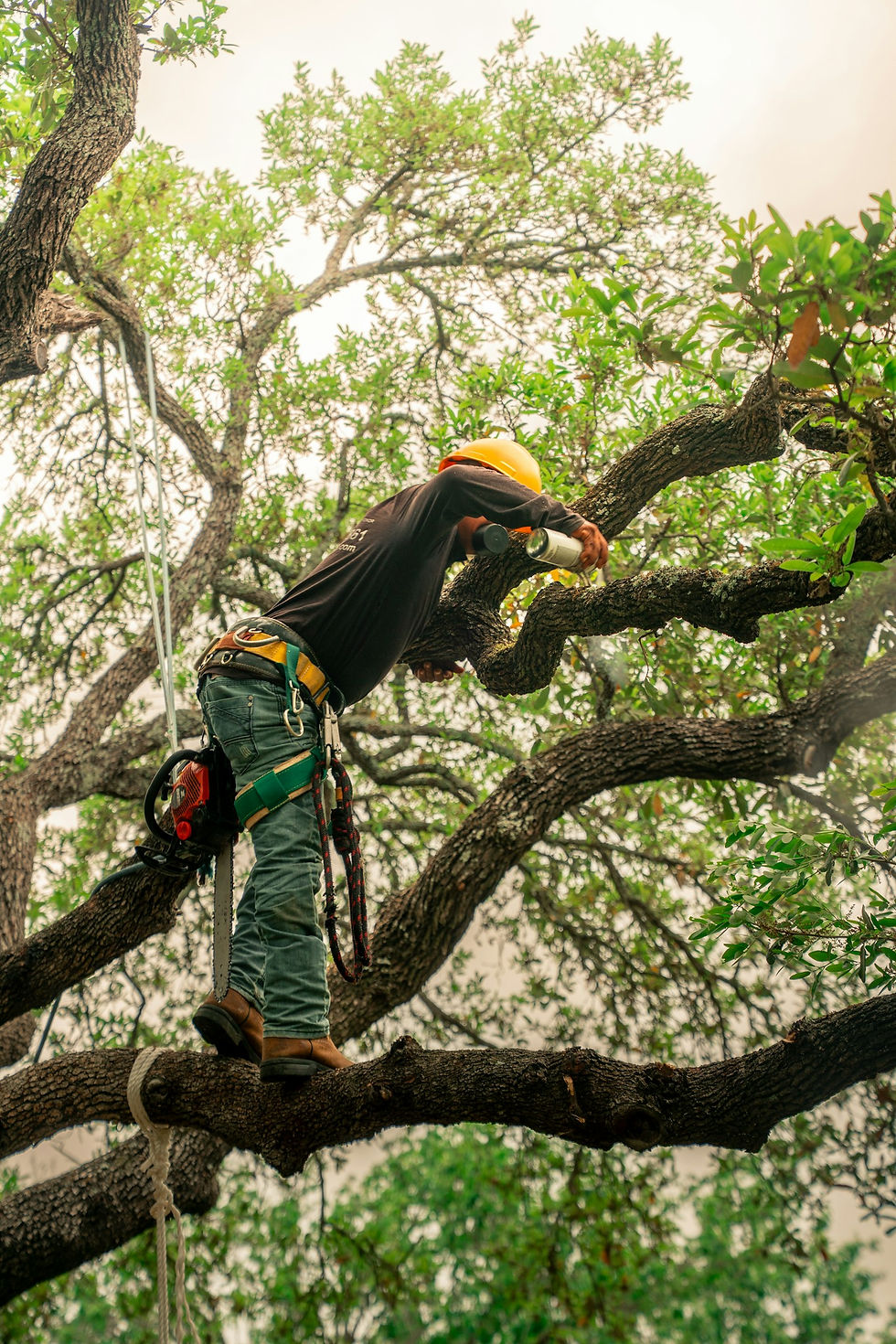
Climbing dead ash is risky for tree workers, so removal methods change once a tree is badly decayed.
Removal costs often rise as the tree deteriorates, because more rigging or equipment is needed.
If a dead ash could hit your house, garage, a fence, a driveway, power lines or a neighbour's property, don't wait.

London's Tree Protection By-law: what applies to dead trees
London's Tree Protection By-law applies to private trees in two main situations:
Distinctive trees: trees with a trunk diameter of 50 cm or more, measured 1.4 m above the ground, on private property inside the Urban Growth Boundary.
Tree Protection Areas: trees of any size in designated areas.
Dead trees aren't automatically exempt. To remove a dead distinctive tree, you need a Dead Distinctive Tree Permit, supported by an arborist's opinion that the tree is dead or in advanced, irreversible decline.
There are specific exemptions. These include destroying a tree that is an immediate threat to health or safety, and removal required by a Property Standards Order. A boundary tree shared with a neighbour needs consent from all owners. Questions go to the City at trees@london.ca or 519-661-5783.
For a broader look at London's tree rules and timing, see our post on tree pruning and removal by-laws in London.
Removal options: a quick comparison
Small ash, open yard, nothing nearby: Felled in one piece
Medium ash near a fence or garden: Sectioned down from the top
Large or badly decayed ash near a house: Lift equipment or rigging; no climbing on brittle wood
Ash near power lines: Utility must be involved; never DIY
Stump left behind: Grind, or excavate if you're regrading
What to do with the wood: firewood rules
EAB is still a regulated pest in Canada. The CFIA's directive on EAB is in force, and Middlesex County is within the regulated area. CFIA rules prohibit moving ash firewood out of regulated areas, and penalties under the Plant Protection Act can be significant.
Practical advice:
Burn local. CFIA's guidance is "buy local, burn local."
Don't take ash firewood to the cottage in Grand Bend, Bayfield or further north without checking CFIA rules for your route.
Chip it. Chipping is a common way to handle ash branches on site.
Ask your contractor how the wood will be disposed of.
After removal: replanting and lawn repair
Removing a big ash often leaves a stump, a hole of roots, and a patch of damaged lawn. Options include:
Stump grinding and filling the hole with topsoil.
Replanting with a non-ash species suited to the site. A mix of species is more resilient to future pests.
Regrading and sodding if heavy equipment rutted the yard. See our sod installation page.
Local angle: ash in London's older neighbourhoods and rural lots
Mature neighbourhoods such as Old North, Byron and Old South have large backyard trees, and many were ash. On rural lots in Middlesex Centre, Thames Centre and Strathroy-Caradoc, dead ash often line fence rows and woodlot edges. Winter is often the best time to remove them, because frozen ground supports equipment better and there are no leaves blocking the view of the crown.
Hiring someone to remove an ash tree
Before you sign, ask the contractor whether they carry WSIB coverage and liability insurance, how they will bring the tree down near buildings, whether wood and branches are removed or left on site, and whether stump grinding and lawn repair are included. Get it in writing so there are no surprises on removal day.
EAB tree checklist
☐ Confirm the tree is an ash
☐ Look for crown dieback, D-shaped holes and woodpecker damage
☐ Measure trunk diameter at 1.4 m (is it 50 cm or more?)
☐ Check whether you're inside London's Urban Growth Boundary or a Tree Protection Area
☐ Get an arborist's opinion if a permit is needed
☐ Talk to your neighbour about a boundary tree
☐ Plan wood disposal under CFIA rules
☐ Plan stump grinding, topsoil and sod or replanting
FAQ
Do I need a permit to cut down a dead ash tree in London, Ontario?
If the tree is 50 cm or more in trunk diameter, measured 1.4 m above the ground, on private land inside the Urban Growth Boundary, you need a Dead Distinctive Tree Permit, supported by an arborist's opinion. Trees in Tree Protection Areas are covered at any size. Exemptions include an immediate threat to health or safety.
Is emerald ash borer still regulated in Canada?
Yes. CFIA's directive on emerald ash borer is in force, and Middlesex County is within the regulated area. Moving ash firewood out of regulated areas is prohibited.
How can I tell if my ash tree is dead from EAB?
Look for a thinning crown with dead branches at the top, D-shaped exit holes in the bark, S-shaped tunnels under loose bark, woodpecker damage, and shoots sprouting from the trunk.
Can a dead ash tree be saved?
Treatment can protect healthy or lightly infested ash, but trees with heavy crown dieback are usually beyond saving. An arborist can assess your tree.
When is the best time to remove a dead ash?
As soon as it's dead or declining, especially if it's near a building, driveway or power lines. Late fall and winter often work well because the ground is firm and leaves are down.
Get your dead ash removed safely
SPM Landscape & Excavation has offered tree trimming and removal across London since 2006, along with stump cleanup, grading and sod. We are WSIB covered and carry $1 million in liability insurance. See examples in our photo gallery, call (519) 474-0008, or email spmlandscape@gmail.com.


Comments